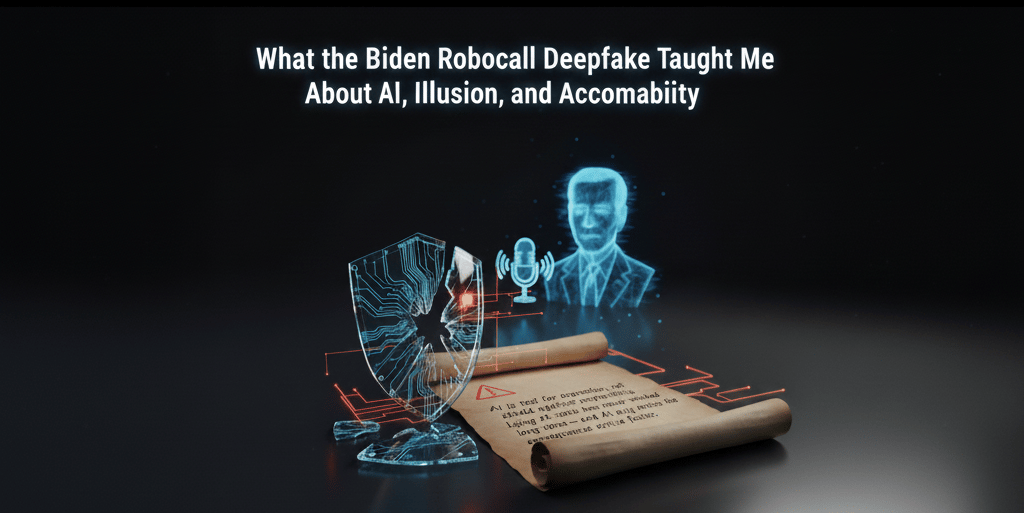
What the Biden Robocall Deepfake Taught Me About AI, Illusion, and Accountability
AI, Illusion, and Accountability
1/2/20262 min read
What the Biden Robocall Deepfake Taught Me About AI, Illusion, and Accountability
As an AI magician, I live at the intersection of illusion, technology, and trust. My work is about showing people what’s possible while never crossing the line into deception that harms or manipulates.
That’s why the recent robocall deepfake impersonating Joe Biden stood out to me as more than just another AI controversy. It was a clear example of what happens when someone mistakes technical capability for ethical permission.
The consultant behind the stunt, Steve Kramer, didn’t uncover a clever loophole in AI law or creative expression. He demonstrated exactly how fast credibility collapses when illusion is used without consent, context, or transparency.
You Can Use the Tools. That Was Never the Question.
AI voice cloning exists.
Synthetic media exists.
Generative systems exist.
None of that is shocking anymore.
What still seems to confuse people is the idea that using AI somehow softens responsibility. It doesn’t. It sharpens it.
People often ask creators like me, “What if someone uses your art or tools in ways you didn’t intend?”
The honest answer is: they can.
But intent does not shield anyone from accountability.
Illusion Has Rules. Deception Breaks Them.
Magic has always relied on illusion, but it has never relied on lies that damage real-world trust. Audiences know they are watching something crafted. There is an unspoken agreement.
The Biden robocall violated that agreement entirely.
It wasn’t parody.
It wasn’t satire.
It wasn’t clearly framed fiction.
It was impersonation designed to mislead real people in a real civic process.
That distinction matters.
Art can be reused, remixed, and reinterpreted. Deception, when scaled, always leaves evidence and consequences behind.
AI Doesn’t Remove Responsibility. It Amplifies It.
One of the most dangerous myths in the AI space is that blame can be outsourced to the model, the software, or the algorithm.
That argument does not survive contact with reality.
AI accelerates reach.
It magnifies impact.
It compresses timelines.
So when something goes wrong, the fallout moves just as fast.
In this case, the outcome was predictable:
– Investigations followed
– Public exposure escalated
– Legal scrutiny intensified
– Professional credibility evaporated
Not because AI was involved, but because trust was violated.
The Line Is Clear (Even If People Pretend It Isn’t)
If you’re using AI to:
– Create art
– Explore ideas
– Entertain audiences
– Educate responsibly
– Signal satire or fiction clearly
You’re operating within a defensible and creative space.
If you’re using AI to:
– Impersonate real people
– Fabricate authority
– Mislead voters
– Manipulate public trust
You are building something that will not survive scrutiny.
Every time.
The Real Risk Isn’t AI. It’s Arrogance.
The biggest failure in most AI scandals isn’t technological. It’s psychological.
It’s the belief that being clever makes you untouchable.
It doesn’t.
Reputations take years to build and minutes to destroy. In the AI era, that timeline is even shorter. When illusion crosses into deception, the collapse is immediate and permanent.
The future belongs to creators, clients, and organizations who understand this early:
AI is a tool for expression, not a shield against responsibility.
Use the tools.
Push boundaries with intention.
Respect the line.
Because lying at scale has never worked long-term — and AI only makes the consequences arrive faster.
— Paul David Carpenter
AI Magician