The Suno Backlash
the Question We Keep Avoiding: What Is an Artist, Really?
1/1/20264 min read
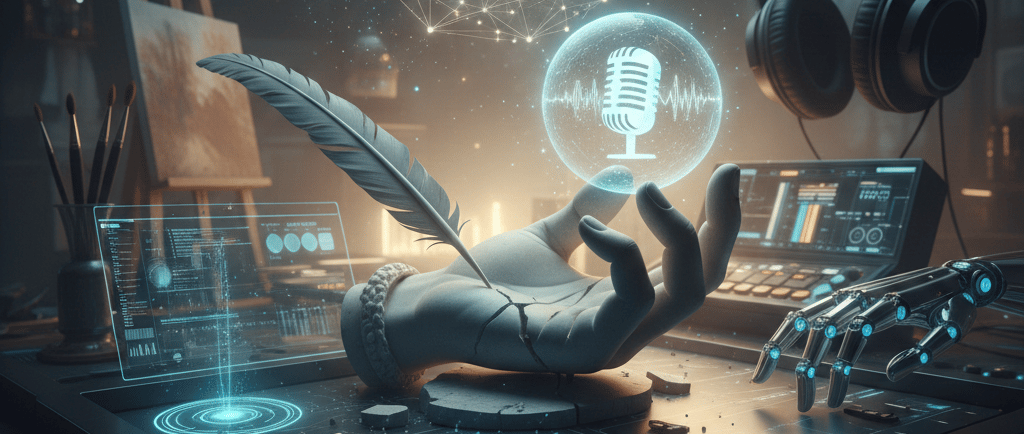
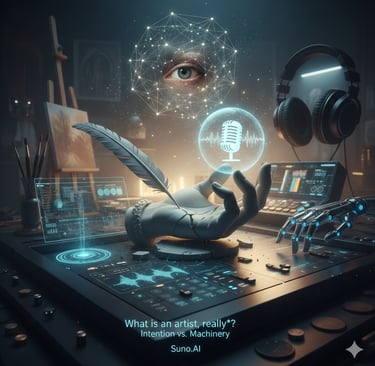
The Suno Backlash and the Question We Keep Avoiding: What Is an Artist, Really?
Every generation redraws the boundary around what counts as art.
Photography was not art.
Sampling was theft.
Auto-Tune was fraud.
Now it’s AI music. And at the center of the latest debate is Suno, one of the fastest-growing AI music platforms.
Suno is able to generate full songs from text prompts — and has even added a paid feature that lets users upload their own vocal recordings, then produce a fully realized track from it, without a studio or thousands of dollars in production costs. This means people who couldn’t afford professional studio time can now create polished tracks from their own voice and ideas.
That capability is revolutionary — and it’s also one of the reasons the Suno announcement attracted a barrage of anger online.
A creator recently shared that they’d released over 130 Suno-assisted songs in under 60 days. The comment thread that followed was vindictive and personal:
“Talentless poser.”
“Microwaving a TV dinner and calling yourself a chef.”
“Your caption looks AI-generated.”
This reaction isn’t really about music. It’s about identity, craft, and fear.
It forces us to confront something old and seldom said directly:
We no longer agree on what an artist is.
The Myth of Suffering as Legitimacy
4
Many critics cling to the idea that pain and years of manual practice are prerequisites for real artistry.
But art history doesn’t support that.
Renaissance masters like Titian and Rubens ran workshops where apprentices did most of the painting while the master provided the vision. The signed name was the director’s — not every brush stroke.
Andy Warhol’s Factory embraced delegation as a statement. Warhol didn’t paint every piece himself, but that doesn’t make his work less impactful.
In classical music, composers write, but musicians perform.
Yet when AI reduces the physical effort, critics interpret it as a lack of meaning.
The real question is not about who pressed the buttons, but who chose the meaning.
Suno’s Vocal Upload Feature Is a Gamechanger
Suno’s vocal upload feature lets musicians record themselves singing and use AI to produce a full track — vocals, backing instruments, mixing, and mastering — without a traditional studio. This kind of democratization is new in music in the way digital cameras were to photography.
For many, that’s liberation. For others, it’s perceived as cheating. But being able to produce and express without capital or gatekeepers is exactly what past artistic revolutions enabled — and what pressure from the market often tried to resist.
Whether you like the music matters far less than what this capability represents: a shared expansion of access to artistic tools.
A Case in Point: Paul David Carpenter, AI Magician and Musician
One artist using tools like Suno to push music that otherwise might not exist is Paul David Carpenter, also known as the AI Magician. Carpenter blends AI, performance, and art to explore the cultural and perceptual impact of machine intelligence while creating real works across music, magic, and writing. Paul Carpenter / Ai Magician
In December 2025, Paul released “DIST / RUCTION” — a track and visual experience built with contemporary creative tools that include AI-assisted production, transforming a song he wrote decades earlier into a fully realized music video:
🎵 “DIST / RUCTION” by Paul David Carpenter — press release: Paul Carpenter Releases ‘DIST / RUCTION’ and Music Video (Finance.yahoo.com)
Paul’s work shows exactly what Suno and similar platforms make possible: a blend of human voice, vision, and machine collaboration that would typically require years of training or a production budget most people don’t have. Paul Carpenter / Ai Magician
Follow Paul’s art and music here:
• Website: https://pauldavidcarpenter.com/ Paul Carpenter / Ai Magician
• LinkedIn: Paul David Carpenter – AI Magician LinkedIn
• Instagram: @mentallyhyp Instagram
What People Are Really Angry About
Let’s parse the negative reactions:
1. Oversaturation
Releasing 130 songs in 60 days feels like signal noise — that’s a distribution problem, not inherently an art problem.
2. Identity and Training
Many musicians invested years mastering instruments and theory. AI challenges the narrative that physical mastery is art’s only gateway.
3. Loss of Gatekeeping
When anyone can generate high-quality output, status hierarchies feel threatened.
None of these are purely aesthetic critiques. They are social anxieties about meaning, value, and future livelihoods.
Effort Is Not the Same as Value
Effort matters — but effort alone has never defined artistic value. Human labor has often been invisible in art’s final form:
Renaissance studios
Film crews
Recording engineers
Ghostwriters
Producers
AI shifts where effort happens: from manual execution to conceptual direction, iteration, and curation.
Low-effort AI music exists — just as low-effort guitar pop exists. The problem is taste and discernment, not the tools themselves.
Redefining the Artist for This Era
An artist is not a muscle or a machine.
An artist is someone who:
✔ makes intentional choices
✔ communicates emotional or conceptual meaning
✔ curates, refines, edits
✔ stands behind their work
If someone uses AI to explore voice, narrative, and emotional resonance with intention and craft, that is participation in an artistic lineage — not its destruction.
If someone dumps raw output without discernment, that’s a quality issue, not a tool issue.
The real question for our generation isn’t whether AI belongs in art.
It’s whether we can separate meaning from myth, and intention from machinery.
Because throughout history, artists have always been those who direct meaning — not just those who execute the mechanics of creation.
AI didn’t change that — it just made it impossible to ignore.