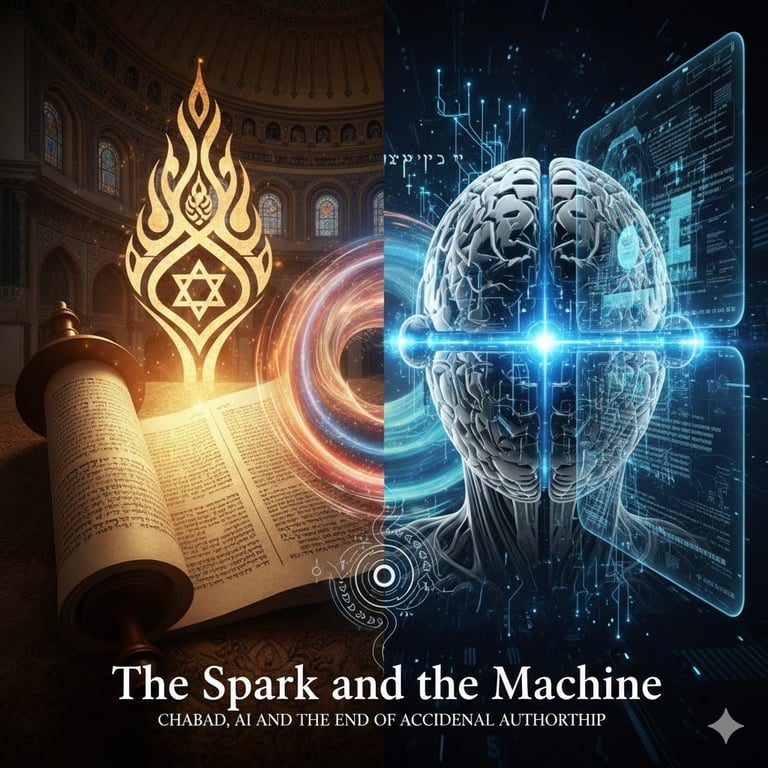
The Spark and the Machine
Chabad, AI, and the End of Accidental Authorship
1/18/20263 min read
The Spark and the Machine: Chabad, AI, and the End of Accidental Authorship
Artificial intelligence has forced a question that technology alone cannot answer:
Who is the creator when creation no longer requires hands?
We argue about whether something was “made by AI” or “made by a human,” as if authorship were a binary switch. But that question is already outdated. It assumes creation is about execution.
It never was.
Long before machines could write, paint, compose, or speak, Chabad philosophy outlined a model of creation that feels uncannily suited for this moment. Not as theology, but as a map of how ideas become real.
Chabad breaks creation into three core movements:
Chochmah – the spark
Binah – the shaping
Da’at – the choice
AI did not disrupt this process.
It exposed it.
Chochmah: The Spark Cannot Be Automated
Chochmah is the flash.
The pre-verbal insight.
The moment before language exists.
It is not logic.
It is not output.
It is not calculation.
It is the question that appears unannounced.
AI does not generate Chochmah.
No matter how advanced the model, AI only responds. It never wonders. It never intends. It never wakes up with a sense that something must be said.
Every AI interaction begins with a human spark, even when that spark is lazy, unconscious, or poorly formed.
No prompt, no output.
That alone disqualifies the idea of “purely AI-made” creation. A machine can continue endlessly, but it cannot originate meaning. It can only rearrange it.
The spark is human, whether we acknowledge it or not.
Binah: Prompting Is Not Asking, It Is Shaping
Binah takes the spark and stretches it into form.
This is where most people misunderstand prompting.
A prompt is not a request.
It is a container.
It sets boundaries, tone, direction, scale, and intent. It determines whether the output will feel shallow or profound, generic or authored.
This is why:
vague prompts produce disposable content
precise prompts produce work that feels deliberate
skilled users make AI look intelligent
unskilled users make it look hollow
The intelligence does not change.
The framing does.
Binah is not creativity.
It is structure.
And structure determines outcome.
Da’at: Choice Is Where Authorship Lives
Da’at is the step people forget because it is invisible.
Da’at is not knowledge.
It is commitment.
It is the moment where abstraction becomes owned.
In AI creation, Da’at appears as:
selecting one output over another
rejecting what does not resonate
refining language, tone, pacing
knowing when something is finished
AI can generate endlessly.
Only a human decides when something is right.
This is the critical line:
Choice is authorship.
The person who selects, curates, edits, and releases is not a user. They are a producer.
When the Prompter Becomes the Producer
Here is the transition point most people miss:
The prompter becomes the producer the moment they stop being surprised by the output.
Early users react.
Producers anticipate.
A producer understands the system well enough to:
predict ranges of outcomes
guide toward a specific result
correct deviation
stop generation intentionally
This is no different than:
a film director working with actors
a conductor guiding an orchestra
a magician directing attention
The orchestra makes the sound.
The conductor makes the music.
AI is not the artist.
It is the instrument.
The Myth of “Pure AI” Creation
There is no such thing as purely AI-made content.
Even autonomous systems are:
trained on human artifacts
deployed by human intention
evaluated by human standards
released into human culture
AI can iterate without fatigue.
It cannot care.
It cannot mean.
The myth of pure AI authorship exists because humans increasingly abdicate intention. When intention disappears, authorship feels ambiguous.
But ambiguity is not absence.
It is neglect.
The Real Question Is Not Who Made This
The wrong question:
“Was this made by a human or an AI?”
The right question:
Where did the intention live?
If intention lives in the human, AI is a tool.
If intention is unconscious, AI becomes a mirror.
If intention is outsourced entirely, authorship collapses.
And when authorship collapses, so does responsibility.
The End of Accidental Authorship
For most of history, people created accidentally.
They wrote without realizing what they were saying.
They repeated patterns without seeing them.
AI ends that era.
It forces us to confront a truth we could previously ignore:
If you do not choose your intention, something else will.
The spark still belongs to us.
The machine only reveals how we use it.
Creation has not been taken from humans.
It has been clarified.