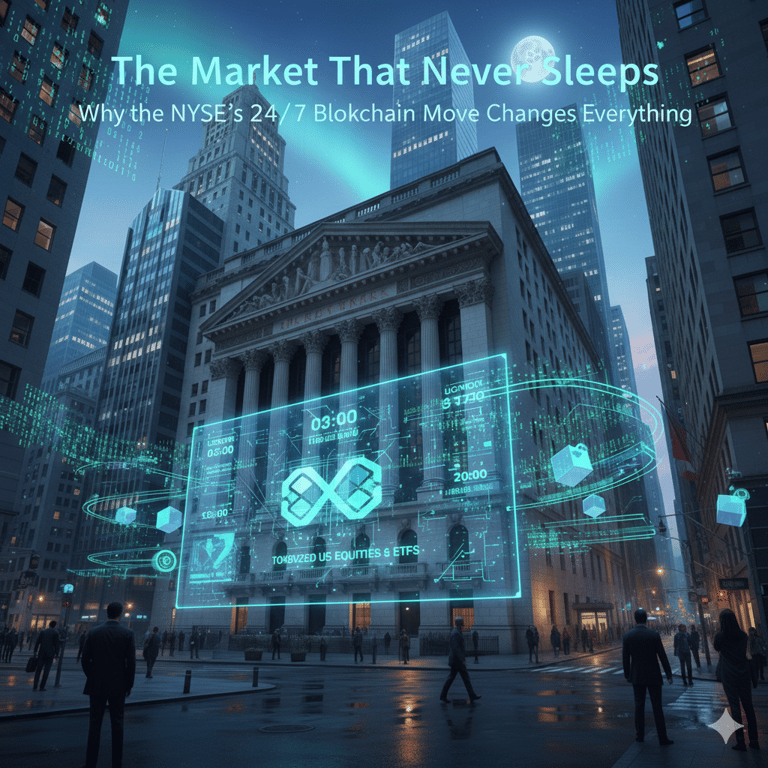
The Market That Never Sleeps
Why the NYSE’s 24/7 Blockchain Move Changes Everything
1/20/20264 min read
The Market That Never Sleeps
Why the NYSE’s 24/7 Blockchain Move Changes Everything
For more than three centuries, stock markets have obeyed the same rule.
They open.
They close.
They sleep.
That rule just broke.
On January 19, a federal holiday honoring Martin Luther King Jr., when U.S. markets were closed, the New York Stock Exchange announced it is developing a 24/7 trading and settlement platform built on blockchain infrastructure, pending regulatory approval.
The timing was not accidental. Markets were closed, but the message was open.
This was not a press release about extended hours. It was an announcement about replacing the rails beneath the entire system.
What the NYSE Actually Announced
Through its parent company Intercontinental Exchange, the NYSE confirmed it is building a blockchain based platform for tokenized U.S. equities and ETFs designed to operate continuously, twenty four hours a day, seven days a week.
The platform is intended to support:
Tokenized shares that are legally equivalent to traditional equities
Continuous trading, not just pre market or after hours
On chain settlement that could eliminate the T+1 settlement cycle
Dollar based order sizing rather than fixed share quantities
Integration with tokenized deposits and stablecoin style settlement assets
This is not a crypto exchange listing stock like products. The NYSE has been explicit on this point.
These are not derivatives.
Not synthetics.
Not wrappers.
The intent is full fungibility. Same stock. Same dividend. Same voting rights. Different infrastructure.
Why Settlement Matters More Than Trading Hours
The most disruptive part of this announcement is not 24/7 access. It is settlement finality.
Today, when you buy a stock, ownership does not actually change hands immediately. Trades are netted, reconciled, and settled through clearinghouses one business day later. This delay exists to manage risk in a system built for paper ledgers and batch processing.
Blockchain systems do not work that way.
On chain settlement can occur in real time. Once the transaction is validated, it is final. No overnight exposure. No reconciliation lag. No waiting for tomorrow to find out if today actually happened.
Peer reviewed research and central bank studies have repeatedly shown that shortening settlement cycles:
Reduces counterparty risk
Frees up collateral locked in margin requirements
Lowers systemic exposure during periods of stress
The DTCC has estimated that hundreds of billions, potentially trillions, of dollars are immobilized due to settlement delays. Instant settlement releases that capital back into the system.
That is not a marginal efficiency gain. That is a structural change.
Tokenized Shares Are Not a Gimmick
Tokenization in this context does not mean speculative assets floating outside regulation. It means representing legally recognized securities on a distributed ledger.
Academic research from institutions like MIT, the Bank for International Settlements, and the World Economic Forum has consistently found that tokenization does not alter ownership rights if legal frameworks are preserved. It simply changes how ownership is recorded and transferred.
The NYSE’s approach aligns with this research:
Shares remain registered securities
Corporate actions are preserved
Shareholder rights remain intact
The difference is that ownership can now move instantly, globally, without banking hour constraints.
This is Wall Street adopting crypto mechanics, not crypto pretending to be Wall Street.
Stablecoins and Tokenized Money Inside the Clearing System
One of the least discussed but most important aspects of the announcement is money itself.
The NYSE confirmed it is working with major institutions like BNY Mellon and Citigroup on tokenized deposit infrastructure. This means real bank money, represented on chain, usable for settlement and margin inside regulated clearing environments.
This matters because banks have been the bottleneck.
Markets can trade fast. Money moves slowly.
If margin calls, collateral adjustments, and settlements can be handled using tokenized deposits that move instantly, then the entire risk model of clearinghouses changes.
A margin call at 3 a.m. Tokyo time no longer waits for New York banking hours. It settles immediately.
Time zones stop being friction.
The Jobs That Exist Because Time Exists
There is a hard truth buried in this transition.
A massive portion of financial employment exists to manage delay.
Clearing.
Reconciliation.
Back office operations.
Custody verification.
These roles are not inefficiencies because people are bad at their jobs. They exist because the system is slow by design.
When settlement becomes instant, many of these functions collapse into code.
This is not optimization.
It is obsolescence.
The NYSE does not say this explicitly. It does not need to. The technology speaks for itself.
Global Pressure and Competitive Reality
The U.S. equity market represents roughly 65 percent of global equity value.
If U.S. markets become continuously accessible, the pressure on every other exchange becomes existential.
London. Frankfurt. Tokyo. Hong Kong.
If one market never closes and yours does, global capital will notice. Liquidity follows access.
Other exchanges will have two options:
Copy the model or become regional.
This is not theoretical. Crypto markets already demonstrated what happens when capital gains twenty four hour mobility. Traditional exchanges are now responding.
The Real Risks No One Should Ignore
This transition is not without danger.
Spreading the same trading volume across twenty four hours risks liquidity fragmentation. Bid ask spreads can widen during low activity windows. Price discovery can weaken.
There is also volatility risk.
Traditional markets rely on circuit breakers tuned to specific hours. Continuous markets require continuous risk controls. A flash crash at four in the morning with thin liquidity is not a hypothetical. It is a certainty without safeguards.
Academic market microstructure research shows that liquidity incentives and market making programs will need to evolve for this model to be stable.
Technology alone does not solve this. Governance matters.
Regulation Is the Final Gate
Nothing described here is live yet.
Everything depends on regulatory approval, particularly from the SEC. The NYSE has framed this platform carefully within existing securities law, but approval is not guaranteed or automatic.
That said, the direction is unmistakable.
Nasdaq has proposed similar tokenization initiatives. Central banks are experimenting with tokenized settlement assets. The BIS has published multiple papers supporting atomic settlement models.
This is not an outlier. It is convergence.
Why the Holiday Announcement Matters
January 19.
Markets closed.
No trading. No volume. No noise.
That was the point.
The announcement was not meant to move prices. It was meant to signal a problem.
Markets that sleep are friction.
Friction is cost.
Cost is vulnerability.
The NYSE did not announce a feature. It announced an admission.
The old rails cannot carry the future.
Welcome to the market that never turns off.