The Helmet Generation: Becoming Invisible in a World That Watches Everything
Becoming Invisible in a World That Watches Everything
1/15/20263 min read
The Helmet Generation: Becoming Invisible in a World That Watches Everything
The future is not decades away. It is not science fiction. It is arriving quietly, in increments, and within the next two to three years it will feel unmistakable.
We are entering a world where seeing and being seen are no longer neutral acts.
Cameras already blanket neighborhoods. Doorbells watch sidewalks. Cars map streets. Retail stores, airports, schools, and apartment buildings quietly layer vision on top of daily life. Facial recognition is no longer experimental, it is infrastructural. What began as convenience has evolved into something closer to continuous observation.
As this network grows, a counter-movement is emerging.
Not rebellion in the streets, but withdrawal through technology.
The next personal device will not be a phone. It will be a helmet.
The Rise of the AR / VR / XR Helmet
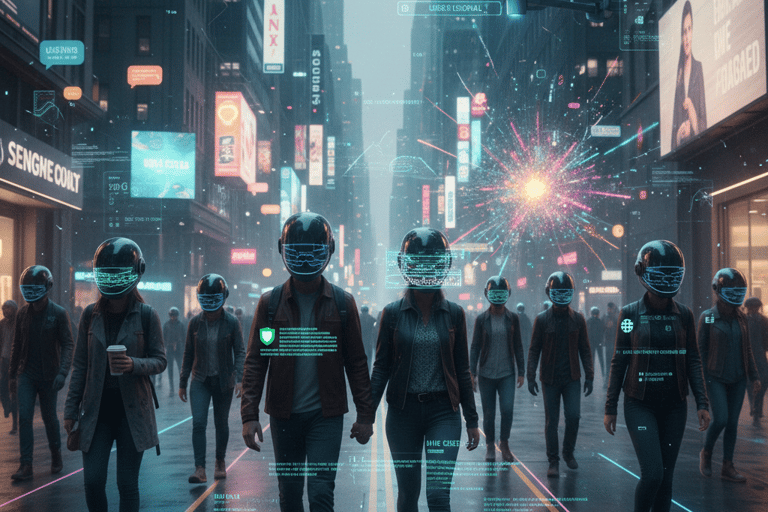
Within the next few years, lightweight mixed-reality helmets will become normal. Not bulky gaming headsets, but sleek, wearable systems designed to be worn in public. These helmets will cover the face, obscure identifying features, and project digital layers onto the physical world.
Users will still walk the same streets, shop in the same stores, and interact with the same people. But their interface with reality will be mediated. Information will float where screens once lived. Navigation, communication, entertainment, and work will all happen inside the helmet.
The key difference is not immersion.
It is control.
These helmets will allow people to exist in public space while selectively disappearing from machine vision. Facial recognition systems will no longer see a human face. They will see an object. A shell. Noise instead of identity.
For the first time in decades, individuals will have a way to opt out of passive biometric capture without opting out of society itself.
Anonymous by Design
This physical anonymity will pair with a new generation of privacy-first software.
Future browsers will go far beyond today’s VPNs. Onion-style routing, decentralized identity layers, encrypted social spaces, and obfuscated metadata will become default for people who choose it. Not criminals, not extremists, just individuals who do not consent to being profiled.
Gaming communities will become the proving ground.
Players will move between worlds without persistent identity. No unified profile. No behavioral shadow following them from game to platform to marketplace. Presence without trace.
The helmet becomes both portal and shield.
You are online.
You are present.
You are not cataloged.
The Hacker Layer
Every system creates its counter-system.
Alongside consumer helmets will emerge a parallel ecosystem of hackers, engineers, and privacy specialists. Not chaotic attackers, but craftsmen of disappearance.
Their work will not be loud. It will be subtle.
When a tracking request pings a helmet, the signal will fragment. When location data is requested, it will be delayed, mirrored, or displaced. Some helmets will appear to jump locations. Others will dissolve into static. To centralized systems, the user will simply fail to resolve.
Not invisible in a mystical sense.
Invisible in a technical one.
This creates a cat-and-mouse dynamic where surveillance systems are never sure whether a gap is an error, a ghost, or a deliberate refusal to be seen.
This Was Predicted
None of this is new.
Nearly a decade ago, filmmaker and futurist Keiichi Matsuda released a short film titled Hyper-Reality. The piece depicted a world saturated with augmented reality overlays, behavioral nudges, ads, social scoring, and digital noise layered relentlessly onto everyday life.
What made the film unsettling was not its exaggeration, but its accuracy.
Helmets.
Overlays.
Gamified existence.
Hackers.
Identity fragmentation.
Reality as an interface.
At the time, it felt extreme.
Today, it feels restrained.
The Coming Choice
As surveillance becomes ambient, privacy will stop being a setting and start being a lifestyle.
Some people will accept total visibility in exchange for convenience. Seamless services, personalized everything, frictionless existence.
Others will choose the helmet.
Not to escape reality, but to negotiate with it.
To move through the world without constantly feeding it.
To exist without being harvested.
To be present without being parsed.
The future will not be about hiding.
It will be about choosing when to be legible.
And for the first time in a long time, technology may give individuals the power to say:
You can watch the world.
But you do not get to watch me.