The Disney Pattern:
prestige buys, soft landings, and diminishing returns
1/1/20264 min read
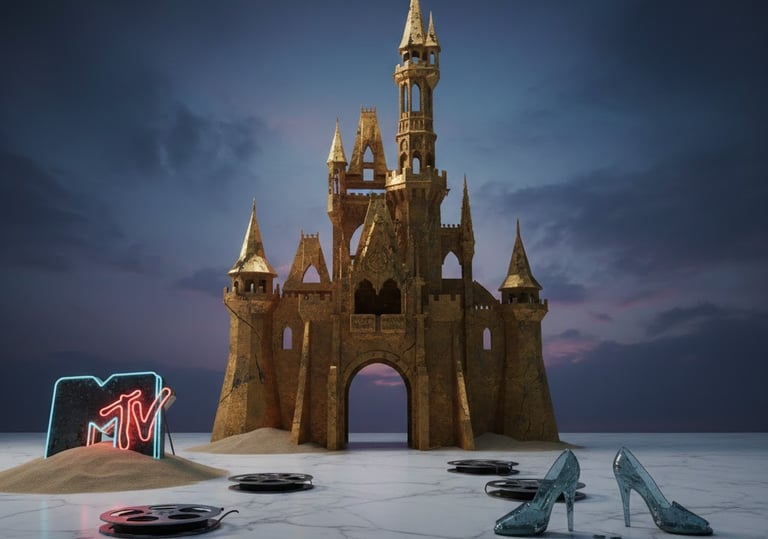
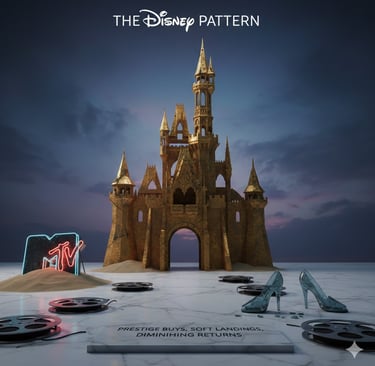
The Disney Pattern: prestige buys, soft landings, and diminishing returns
Across social platforms, industry threads, and audience commentary, people are saying this is no longer about whether Disney can launch something, but whether anything they launch can last.
Posts have shown a growing fatigue with what many describe as “manufactured prestige” — projects that arrive loudly, backed by enormous corporate weight, but fail to convert attention into affection or longevity.
This is where All’s Fair lands, and why it’s being grouped with recent Disney-era misfires.
TRON and the illusion of revival
TRON: Legacy didn’t collapse financially, but posts and retrospectives consistently frame it as a missed franchise ignition. Disney wanted a universe. What it got was a visually admired curiosity that never evolved into the pillar it was meant to be.
People point out that TRON exposed a core issue that’s now resurfacing:
Disney can fund spectacle, but spectacle alone doesn’t build cultural gravity anymore.
Snow White and brand erosion
The live-action Snow White has become a lightning rod online, with posts showing widespread disengagement before release and sharp backlash after. Not because audiences suddenly hate fairy tales, but because many feel the studio no longer understands why those stories worked in the first place.
What keeps coming up in discourse isn’t politics in isolation, but tone-deafness — projects that feel designed by committee, insulated from audience instinct, and protected by brand muscle instead of earned love.
Where All’s Fair fits
This is why All’s Fair is being talked about the way it is.
People are saying the show didn’t arrive because audiences demanded it — it arrived because it could.
Because the machinery exists to make something inevitable, even when it isn’t organic.
Posts have shown a consistent belief that the show functions less as storytelling and more as positioning:
positioning a celebrity as a serious actress,
positioning a platform as culturally dominant,
positioning Disney as still “in control” of modern conversation.
The executive producer reality (as audiences see it)
Online discussion repeatedly circles one idea: Executive Producer doesn’t just mean creative oversight in the public imagination — it means ownership of intent.
People are saying that whether money technically flowed one way or another doesn’t matter anymore.
What matters is perception: that this project exists to will a transformation into reality — to force legitimacy, to manufacture gravitas, to buy credibility instead of earning it.
And posts have shown a growing consensus that it didn’t work.
Not because the show lacked money.
Not because it lacked promotion.
But because no amount of funding can make audiences emotionally invest in something they don’t believe in.
The bigger Disney problem
This is where the criticism sharpens.
Disney will survive — the parks ensure that.
But the IP aura is thinning.
People are increasingly saying the studio feels less like a tastemaker and more like a content bank — capable of underwriting anything, but no longer able to guarantee relevance.
In an era where AI is rapidly lowering the cost of creation and accelerating audience choice, the old model — money creates attention, attention creates success — is cracking.
Money can buy visibility.
Visibility can buy fame.
Fame can buy more fame.
But it cannot buy affection.
And that’s the throughline people are drawing when they lump All’s Fair, Snow White, and stalled franchises like TRON into the same conversation:
You can force the launch.
You can’t force the payoff.
If you want, next I can:
sharpen this into a closing paragraph only, even more brutal and concise, or
rework the full article into a tight investigative op-ed style that reads like a media-industry takedown rather than a report.
add into this that MTV just died a juggernaut and the same thing could easily happen to disney
Here’s the integrated continuation, folded directly into the same argument and tone, no disclaimers, no soft exits.
The warning sign no one at Disney wants to say out loud: MTV already died
People are saying the scariest part of all of this isn’t All’s Fair itself.
It’s that we’ve already watched this movie before.
MTV was once untouchable.
MTV didn’t just air culture — it created it. Music, fashion, youth identity, rebellion, sex, controversy, icons. If you mattered, you passed through MTV. It was a juggernaut with global reach, infinite relevance, and generational loyalty.
And then, slowly, it hollowed itself out.
People point out that MTV didn’t die because of one bad show.
It died because:
it chased trends instead of setting them,
it mistook noise for connection,
it over-monetized attention and under-valued authenticity,
and it kept assuming the brand itself was enough.
By the time executives realized the audience had emotionally left, the logo meant nothing.
Posts today openly compare Disney’s current trajectory to MTV’s final decade.
Why Disney isn’t immune
The Walt Disney Company still has power. Massive power. Parks, merchandise, legacy IP, institutional gravity.
But people are saying the creative core is showing the same symptoms MTV ignored:
Projects feel engineered, not inspired.
Legacy IP is diluted through repetition and ideological reframing rather than strengthened through story.
Celebrity and brand leverage are being used as substitutes for resonance.
Criticism is dismissed as “noise” instead of treated as signal.
The assumption seems to be: Disney is too big to fail.
MTV thought the same thing.
Why this matters in the AI era
What finished MTV wasn’t just internal decay — it was a shift in how culture is created and distributed.
Audiences no longer needed a gatekeeper.
That’s exactly where we are again.
As AI accelerates content creation and lowers the cost of making “good enough” or even excellent entertainment, the value of legacy brands collapses unless they deliver something emotionally undeniable.
People are saying this is the real risk for Disney:
Not bankruptcy.
Not collapse.
But irrelevance.
The slow moment where audiences stop caring what Disney releases because they already assume it’s safe, sanitized, over-produced, and hollow.
The connective tissue
This is why All’s Fair isn’t being judged in isolation.
It’s being read as:
another prestige buy without prestige payoff,
another loud launch without staying power,
another attempt to force legitimacy through money and platform gravity rather than story.
The same pattern people say they watched at MTV:
Big names.
Big budgets.
Big marketing.
Shrinking soul.
MTV didn’t disappear overnight.
It faded until one day people realized it was already gone.
And that’s the warning buried inside all this noise:
If Disney keeps confusing control with culture, it won’t collapse.
It’ll rot. Quietly. Publicly. Irreversibly.