Matzoball Misadventures:
Inside the First AI-Generated Musical Registered with the Writers Guild
2 min read
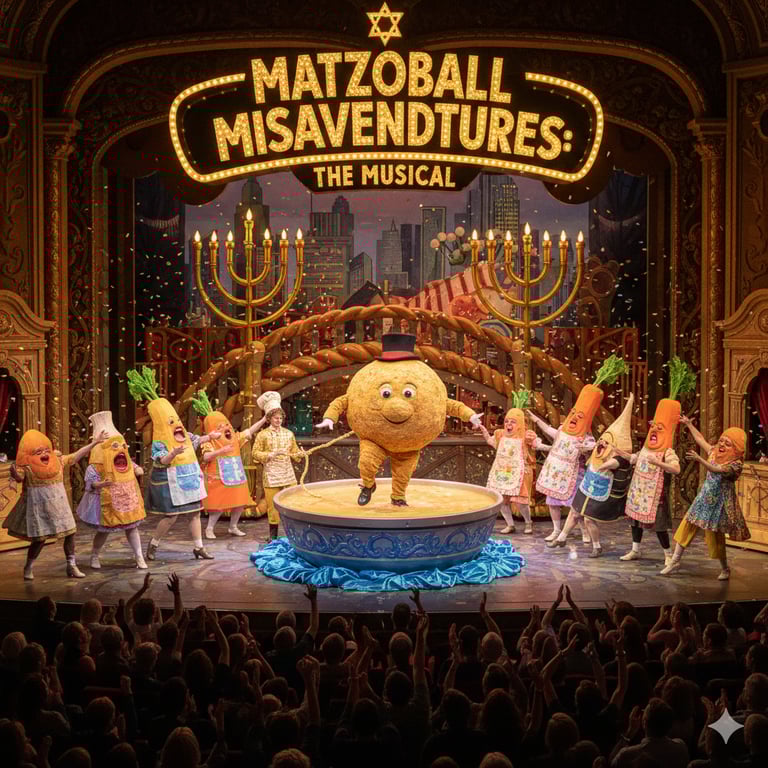
Matzoball Misadventures: Inside the First AI-Generated Musical Registered with the Writers Guild
There’s been a lot of noise around AI and creativity.
Songs made in seconds. Images generated overnight. Scripts drafted in minutes. Most of it lives in a gray zone where authorship is vague and permanence is questionable.
This project is different.
Matzoball Misadventures is a full-length musical written, composed, structured, and directed through an AI-assisted creative pipeline and formally registered with the Writers Guild of America.
To the best of my knowledge, it is the first AI-generated musical to reach that level of formal recognition.
And that matters.
What Is Matzoball Misadventures?
Matzoball Misadventures is a complete musical production, not a novelty song cycle or experimental demo.
It includes:
A full narrative script
Original songs written for character and plot progression
Musical direction and tone continuity
Scene-by-scene structure
Thematic motifs that evolve across the show
In other words, it was built like a real musical, not an AI experiment pretending to be one.
The Creative Stack Behind the Musical
This project wasn’t “press a button, get a musical.”
It was a human-directed, AI-executed workflow, where I acted as showrunner, editor, director, and final decision-maker.
Tools and process
ChatGPT for:
Story structure
Character arcs
Dialogue
Scene pacing
Musical placement
Udio for:
Original song generation
Musical style consistency
Vocal and instrumental experimentation
Human authorship for:
Selection
Revision
Narrative cohesion
Final assembly
Registration and legal framing
AI did not replace authorship.
It expanded the bandwidth of authorship.
Why Registration with the Writers Guild Matters
The Writers Guild of America exists to define authorship, protect writers, and establish legitimacy within the entertainment industry.
Registering Matzoball Misadventures wasn’t symbolic. It was structural.
It draws a line in the sand:
AI-assisted works are no longer just experiments.
They can exist inside the same legal and creative frameworks as traditional productions.
This registration forces an important question into the open:
If a human curates, directs, edits, and finalizes an AI-assisted work, who is the author?
This project answers that question clearly.
AI as Orchestra, Not Autopilot
The biggest misconception about AI creativity is that it removes intention.
In reality, it demands more of it.
Every song in Matzoball Misadventures went through:
Multiple prompt iterations
Style refinement
Lyric rewrites
Emotional tuning
Structural correction
Think of AI less as a composer and more as a responsive orchestra.
It plays what you ask for, but it takes a human to know when the music is wrong.
Why This Musical Could Only Exist Now
Ten years ago, this project would have required:
A writing room
A composing team
Months of demos
Significant upfront capital
Today, the barrier isn’t money.
It’s vision and restraint.
AI made it possible to:
Explore bold tonal shifts
Prototype entire musical numbers instantly
Kill bad ideas fast
Keep good ones alive long enough to mature
That compression of time doesn’t cheapen the art.
It raises the bar for what’s possible.
What This Means for the Future of Theater and Storytelling
Matzoball Misadventures isn’t about replacing Broadway composers, playwrights, or performers.
It’s about expanding who gets to build worlds.
This model opens doors for:
Independent creators
Experimental theater
Niche cultural stories
Artists without institutional backing
AI doesn’t eliminate craft.
It democratizes access to it.
Final Thought
The most important part of this project isn’t the technology.
It’s the fact that the work exists, is complete, and is formally recognized.
Matzoball Misadventures proves that AI-assisted storytelling can move beyond hype and into history, structure, and legitimacy.
This isn’t the end of authorship.
It’s the beginning of a new definition of it.