Lorina Barre: How an AI Influencer Redefined Digital Presence,
Interaction, and Brand Collaboration
2 min read
Lorina Barre: How an AI Influencer Redefined Digital Presence, Interaction, and Brand Collaboration
The rise of AI influencers has been fast, loud, and often shallow.
Most are experiments in aesthetics.
Some are novelties.
Very few are intentional.
Lorina Barre was created to challenge that pattern.
She was designed not as a gimmick, but as a fully realized digital persona capable of narrative consistency, emotional continuity, and real-world brand interaction. And in doing so, she became a first in a category that hadn’t yet been clearly defined.
The Origin of Lorina Barre
Lorina Barre was created by Paul Carpenter as an exploration into what happens when AI is treated not as a content generator, but as a character with structure, boundaries, and intent.
From the beginning, Lorina was built with:
A distinct visual identity
A consistent voice and tone
Cultural awareness
Platform-specific behavior
A long-term narrative arc
She wasn’t meant to imitate humans.
She was meant to exist alongside them.
Her presence now lives independently online, including a centralized link hub at:
👉 https://allmylinks.com/lorinabarre
Beyond Images: An AI Influencer That Interacts
What separates Lorina from most AI influencers is not how she looks.
It’s what she does.
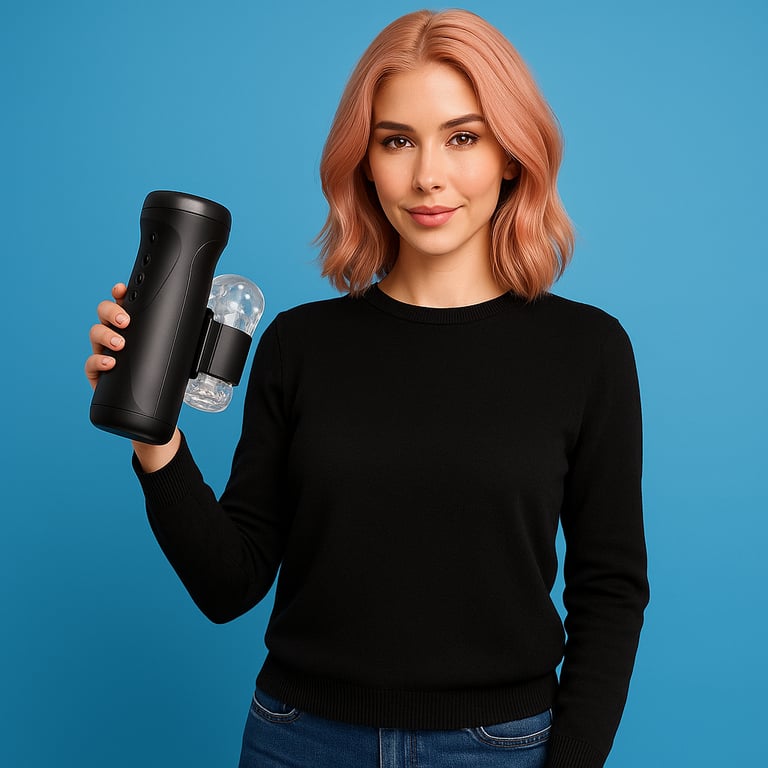
Lorina became the first known AI influencer to promote an interactive physical product, marking a shift from passive digital endorsement to experiential collaboration.
That product was the Handy device, a technology designed to bridge digital content with physical response.
This collaboration wasn’t framed as shock marketing. It was framed as human–machine interaction.
The question wasn’t “Can AI sell products?”
It was:
Can an AI persona meaningfully participate in an experience designed for humans?
Lorina answered that question by becoming part of the interaction loop itself.
Why This Collaboration Mattered
This moment represented several industry firsts happening at once:
An AI influencer participating in interactive hardware promotion
A brand acknowledging AI presence as a legitimate experiential interface
A creator-led AI persona operating independently of a human face
A redefinition of “influence” as engagement, not just reach
As documented in an official press release, the collaboration positioned Lorina not as a mascot, but as a digital entity capable of agency within brand storytelling.
(Press coverage: Access Newswire)
AI as Identity, Not Automation
Lorina Barre was never about replacing models, creators, or influencers.
She exists to explore a more interesting space:
What happens when identity itself becomes programmable, but still guided by human intention?
Every aspect of Lorina’s presence is curated:
Her responses
Her aesthetic evolution
Her collaborations
Her boundaries
AI handles scale.
Humans handle meaning.
That distinction is critical.
The Broader Implications
Lorina Barre is not the end goal.
She’s a prototype.
Her existence points toward a future where:
AI personas act as brand ambassadors
Digital entities hold long-term narrative memory
Interactive products integrate AI as part of the experience
Creators become architects, not just performers
This isn’t about novelty.
It’s about new creative infrastructure.
Final Thoughts
Lorina Barre represents a shift from AI as a tool to AI as a presence.
She demonstrates that with the right structure, intention, and ethical framing, AI influencers can move beyond surface-level content and into meaningful cultural participation.
This project wasn’t built to go viral.
It was built to last, to provoke conversation, and to redefine what influence looks like in a world where digital and physical experiences are no longer separate.
And we’re only at the beginning.