January 1, 2026 Changed AI in America
What the New State AI Laws and Federal Order Really Mean for Creators, Builders, and “AI Magicians”
1/2/20264 min read
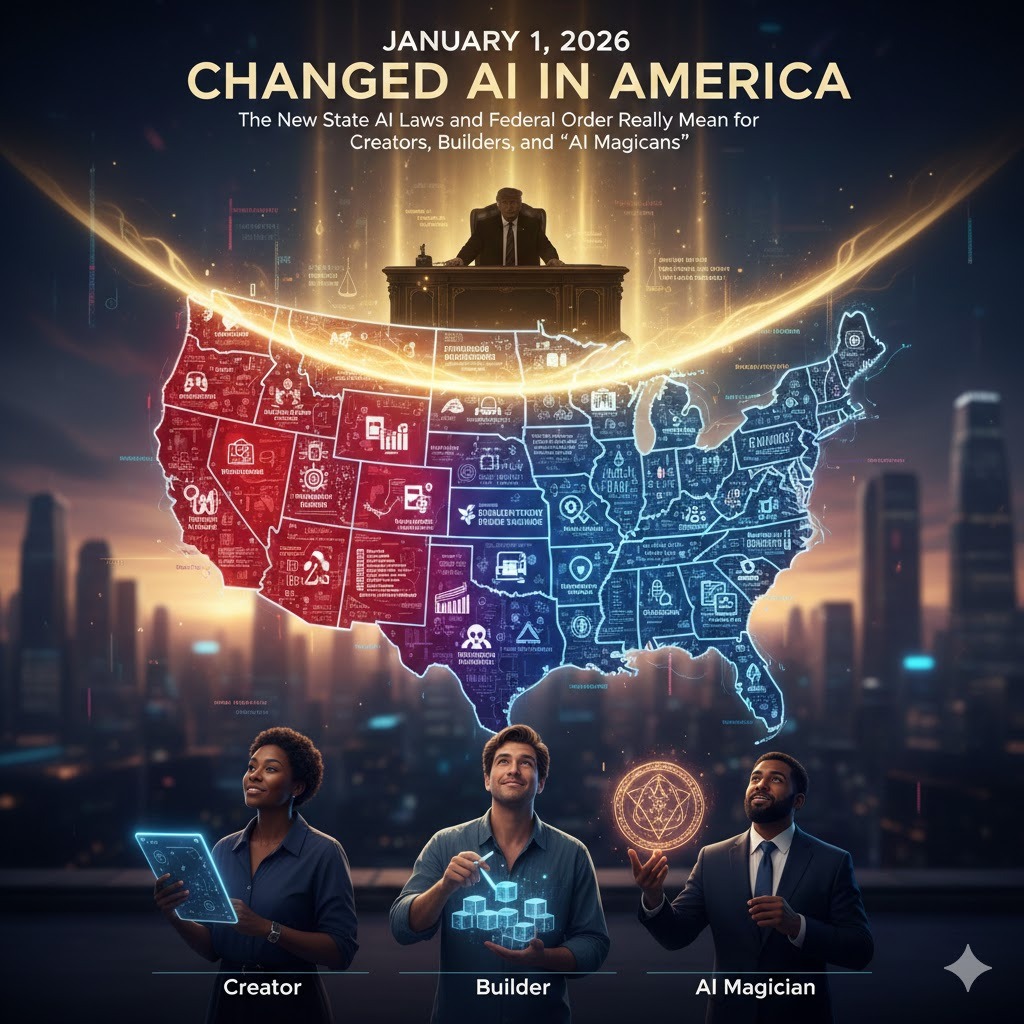
January 1, 2026 Changed AI in America
What the New State AI Laws and Federal Order Really Mean for Creators, Builders, and “AI Magicians”
As of January 1, 2026, artificial intelligence in the United States officially entered a new phase. Not because of one sweeping federal law, but because multiple state-level AI rules went live at once, led by California and Texas, while a new federal executive order stepped in to limit how far states can go.
There is still no single, unified federal AI statute that replaces all state rules. But the White House has clearly started that process.
If you build, deploy, or create with AI—especially generative AI—this matters. A lot.
Let’s break down what actually changed, why it matters, and what it means if you’re an AI creator in 2026.
The Big Picture: What Changed on January 1, 2026
Three things happened at once:
Multiple state AI laws went into effect, covering transparency, frontier models, training data, deepfakes, elections, healthcare, and employment.
California and Texas emerged as the two most influential AI regulatory states, taking very different approaches.
A December 11, 2025 federal executive order signed by Donald Trump began shaping a national AI framework and explicitly targeted certain state laws for preemption.
The result is a fragmented but fast-moving AI legal landscape that creators can no longer ignore.
California: The Most Aggressive AI Regulator in the U.S.
California now has multiple AI statutes active or activating in 2026, making it the most aggressive AI-regulating state in the country.
Frontier Models and Catastrophic Risk
The California Transparency in Frontier Artificial Intelligence Act (TFAIA) took effect on January 1, 2026.
It applies to so-called “frontier AI developers”, defined by extremely high compute thresholds (on the order of 10²⁶ operations).
Companies operating at this level must publish a Frontier AI Framework explaining how they identify and mitigate catastrophic risks, including:
Weaponization
Autonomous cyberattacks
Loss of human control
Deceptive or manipulative model behavior
This is not a suggestion. It’s a public-facing requirement.
Training Data Transparency
California’s Generative AI Training Data Transparency Act requires public-facing AI developers to disclose high-level information about their training data sources.
While the disclosures are not granular, noncompliance carries significant penalties, effectively forcing documentation and disclosure across consumer and foundation models.
Opaque training pipelines are becoming legally risky.
AI Content Detection and Platform Duties
Under California’s AI content and platform transparency laws, large AI platforms must provide free tools that help users detect AI-generated content.
This introduces new obligations around labeling, detection interfaces, and transparency for public-facing AI systems operating in California.
Deepfakes, Explicit Content, and Digital Replicas
California also enacted a bundle of deepfake and explicit-content laws, many of which activate in 2026:
Criminal penalties for AI-generated sexual deepfakes intended to cause emotional harm
Mandatory reporting and removal tools for deepfake nudes on social platforms
Expanded child-protection laws covering AI-generated material
Protection for deceased performers against unauthorized AI recreations
This is one of the clearest lines California has drawn: sexual deepfakes and digital impersonation are no longer gray areas.
Sector-Specific AI Rules
California also targeted specific industries:
Healthcare providers using AI for patient communications must disclose AI use and offer human contact options.
Health insurers face strict limits on algorithmic decision-making, with potential criminal penalties for willful violations.
Texas: Business-Friendly, But Structured
Texas took a different approach.
Texas Responsible Artificial Intelligence Governance Act (RAIGA)
Effective January 1, 2026, RAIGA establishes baseline duties for AI developers and deployers operating in Texas.
Key features include:
Civil penalties for harmful or noncompliant AI systems
A regulatory sandbox and safe-harbor protections tied to recognized risk-management frameworks
State-level preemption of local city and county AI ordinances
Prohibitions on AI systems that encourage self-harm, violence, unlawful discrimination, or harmful deepfakes
Texas wants AI innovation, but with guardrails—and without a patchwork of city rules.
Criminal Deepfake Laws
Texas also criminalized the knowing creation or distribution of non-consensual intimate deepfake media, reinforcing its stance against AI-enabled exploitation.
Other States: Narrow but Growing AI Rules
Beyond California and Texas, many states now have targeted AI laws active in 2026, especially around:
Election deepfakes and political disclosure requirements
Automated decision systems in hiring, housing, and credit
Education and student-data protections
Consumer-protection and bias-mitigation obligations
For the 2026 midterms, AI-generated political content is now a regulated risk in multiple states.
Because the list is long and constantly changing, law-firm trackers and multi-state AI dashboards have become essential references.
The Federal Executive Order That Changes the Game
On December 11, 2025, President Trump signed a sweeping executive order aimed at creating a national AI policy framework.
This order is already in force and matters just as much as the state laws.
What the Order Does
Directs federal agencies to identify state AI laws that may be preempted
Targets state rules that:
Force AI models to alter “truthful” outputs
Compel disclosures that violate First Amendment protections
Orders the FTC to clarify how existing consumer-protection law applies to AI
Tasks the FCC with exploring a federal AI disclosure standard that could override conflicting state rules
Uses federal funding and grants as leverage to discourage overly restrictive state AI laws
What the Order Does Not Preempt
The order explicitly avoids preempting state authority over:
Child safety and AI-generated sexual abuse material
AI infrastructure and data-center development
State government procurement and internal AI use
In other words, speech, disclosure, and ideology are federal battlegrounds now.
What This Means for AI Creators and “AI Magicians”
If you create with AI in 2026:
Transparency is no longer optional in California
Deepfake misuse carries real criminal risk
Texas offers safer experimentation—but only within defined frameworks
Federal preemption may eventually override some state rules, but not yet
The line between “creative AI” and “regulated AI” is shrinking fast
This is the year AI stopped being the Wild West in the United States.
The Bottom Line
January 1, 2026 didn’t bring one AI law.
It brought many, layered on top of each other, with a federal framework now forming above them.
If you’re building, publishing, experimenting, or performing with AI, understanding this landscape is no longer optional. It’s part of the craft.
AI magic still exists—but now, it comes with rules.