I Didn’t Become an AI Magician.
I Realized I Always Was One.
2 min read
For more than twenty years, I worked across magic, mentalism, writing, music, and technology without a clean label. Not because I lacked focus, but because the label didn’t exist yet.
Now it does.
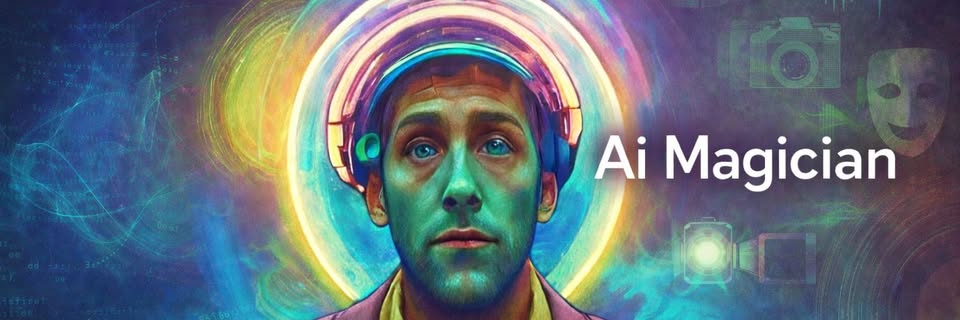
I call it AI Magician.
Not because I use artificial intelligence as a trick, but because AI has become the most powerful belief engine humanity has ever built — and belief has always been the magician’s domain.
The Mistake We Make About AI
Most conversations about artificial intelligence begin with the wrong question:
What can the machine do?
That question misses the point.
The real question is:
Why do humans believe it?
AI doesn’t persuade through truth. It persuades through confidence, speed, and opacity. It speaks fluently. It answers instantly. It rarely admits uncertainty. And humans — wired to defer to perceived intelligence — fill in the rest.
That isn’t a technological breakthrough.
It’s a psychological one.
Magicians have understood this for centuries.
What Magic Has Always Been About
Magic was never about deception for its own sake. It was about attention, authority, and belief.
A magician doesn’t force you to believe.
They create conditions where belief feels like your own idea.
That same mechanism now operates at scale through artificial intelligence.
When an AI system produces language, images, or decisions without hesitation, humans instinctively assign it authority — even when they don’t understand how it works, where it fails, or who is responsible for its output.
That is not intelligence.
That is misdirection.
Why I Stopped Calling Myself Other Things
For years, I used familiar labels: magician, hypnotist, writer, artist, technologist. None of them were wrong. None of them were sufficient.
They described what I did, not what the work was actually about.
My performances weren’t about tricks.
My writing wasn’t about technology.
My music wasn’t about novelty.
They were all examining the same thing: how humans surrender authorship to systems that feel authoritative.
Once I saw that clearly, the label became obvious.
What an AI Magician Actually Does
An AI Magician doesn’t expose how machines work.
That’s not the point.
An AI Magician exposes how belief forms around machines.
In my work, artificial intelligence functions as:
An oracle
An unreliable narrator
A black box authority
A mirror of human projection
The audience isn’t fooled by technology.
They’re confronted with their own assumptions about intelligence, certainty, and control.
Magic becomes a form of literacy.
A safe place to experience misdirection before it carries real-world consequences.
This Wasn’t a Pivot. It Was a Compression.
I didn’t wake up one day and decide to “rebrand.”
I compressed twenty years of work into a coherent frame.
Writing books and essays about AI long before it was fashionable
Releasing AI-generated music and visual narratives in hours, not months
Exhibiting AI-assisted art in cultural spaces
Producing hundreds of performances and videos exploring perception and belief
Watching AI move from novelty to authority in real time
The throughline was always there. I just finally named it.
Why This Matters Now
We are entering a moment where artificial intelligence will not ask permission before shaping decisions, narratives, or identities.
The danger is not that machines will replace humans.
The danger is that humans will stop noticing when they’ve handed over judgment.
Magic has always lived at the threshold where belief forms before understanding. AI now occupies that same space — only faster, louder, and everywhere at once.
Someone needs to stand there and point at it.
That’s the work.
A Final Thought
Artificial intelligence did not introduce a new intelligence into the world.
It revealed how easily humans assign authority to systems that speak with confidence.
Magic has always existed in that gap.
Now, it has a name.
Paul David Carpenter / AI Magician.