
2026: The Rise of Agentic Agents
The Next Evolution of AI
1/16/20264 min read
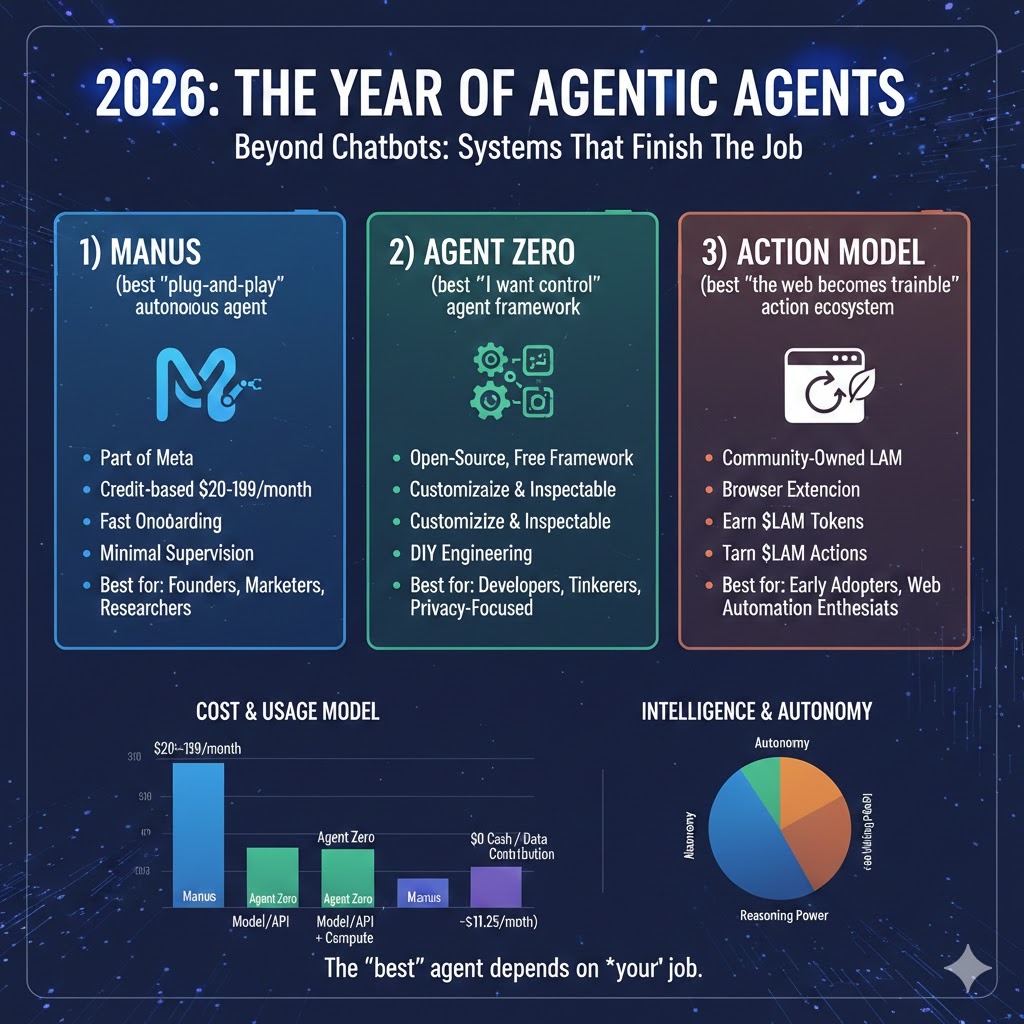
2026: The Year of Agentic Agents
In 2026, the AI conversation shifted from “Which chatbot is smartest?” to “Which system actually finishes the job?”
Agentic platforms are judged by outcomes: can they plan, use tools, operate browsers/apps, recover from errors, and deliver work with minimal supervision.
This article covers three of the most talked-about “agentic style” systems right now:
Manus (productized autonomous agent)
Agent Zero (open-source, user-controlled agent framework)
Action Model (LAM ecosystem trained from real browsing behavior)
Quick definitions
Agentic agent
An AI system that can take a goal and execute multi-step work (research, tool use, browser actions, file ops), not just respond in chat.
LAM (Large Action Model)
A system designed around taking actions, not only generating text, often trained or optimized using real action traces. Salesforce describes LAMs as action-taking cousins to LLMs.
1) Manus (best “plug-and-play” autonomous agent)
What it is: A consumer-friendly “action engine” that aims to execute tasks end-to-end.
Manus is now part of Meta, which increased attention on it as a mainstream agentic product.
Pricing and usage model: Manus uses a credit-based system.
Manus’ help center lists membership pricing starting around $20/month (4,000 credits) and $40/month (8,000 credits).
Third-party breakdowns commonly cite higher tiers going up to about $199/month.
Strengths
Fast onboarding and low setup friction
Strong “agent mode” experience for people who want results with minimal tinkering
Designed as a product, not a framework
Weaknesses
Credit systems can feel unpredictable at higher usage levels (typical complaint for credit-based agent products)
Less transparent than open-source frameworks (you cannot always inspect every tool step)
Best for
Founders, marketers, researchers, operators who want: “Here’s the goal, go do it.”
2) Agent Zero (best “I want control” agent framework)
Important note: there are multiple things called “Agent Zero” online. The “Agent Zero” you referenced is commonly discussed as an open-source agent framework, but there is also a crypto/token-branded “Agent Zero” site. One reliable constant across references is that the framework approach is generally free/open-source, and costs come from the model provider and infrastructure.
What it is: A build-your-own agent framework where you choose the model, tools, memory, and behaviors.
Pricing and usage model
Software/framework: typically free (open-source style)
Ongoing cost: whatever model/API you plug into it, plus your compute
Some Agent Zero communities also reference Venice as an option for “private API” usage.
Strengths
Customizable and inspectable behavior
You pick the models and can swap them as better ones appear
Great for builders who want reliability through engineering, not “magic product promises”
Weaknesses
Setup complexity is real
Reliability depends on how well you design guardrails, tool permissions, and recovery loops
Best for
Developers, tinkerers, privacy-focused users, and anyone who wants “my agent, my rules.”
3) Action Model (best “the web becomes trainable” action ecosystem)
What it is: Action Model positions itself as a community-owned Large Action Model ecosystem. Its browser extension captures web interactions to create training data for LAM behavior.
Pricing and usage model
The extension itself is free, and the system emphasizes “earn points” for contribution.
Docs describe points converting to $LAM tokens at a token generation event (TGE).
Strengths
One of the clearest “LAM” narratives: train models from real action traces, not only text
Rewards and marketplace framing could drive rapid ecosystem growth
Weaknesses
If you want a reliable worker today, it may feel early depending on your exact use case
The value proposition blends automation with tokenomics, which may not be what every user wants
Best for
People excited about the “action-data future,” web automation enthusiasts, early adopters.
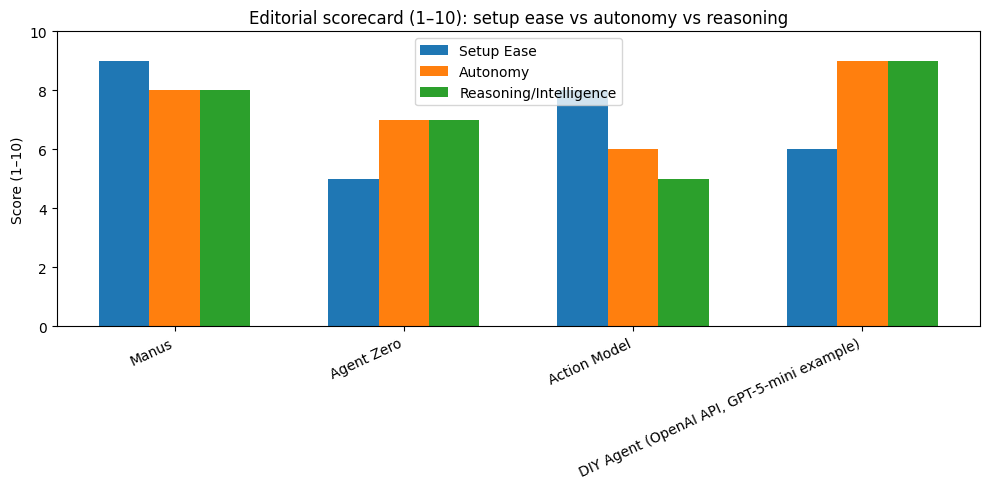
The “best model to use” depends on what you want
This is the core of 2026: there is no single best agent. There is the best agent for your job.
If you want the easiest, fastest results
Pick: Manus
Why: Productized agent experience + credits + research features.
Model choice inside the product: Use the strongest “max” mode when stakes are high, and lighter modes when you are iterating (Manus exposes different modes in Agent Mode).
If you want maximum intelligence per dollar (and you can build)
Pick: DIY agent with OpenAI API + a framework (Agent Zero style approach)
Why: You can pick cost tiers like GPT-5-mini for well-defined tasks.
GPT-5-mini pricing: input ~$0.25/1M tokens, output ~$2/1M tokens
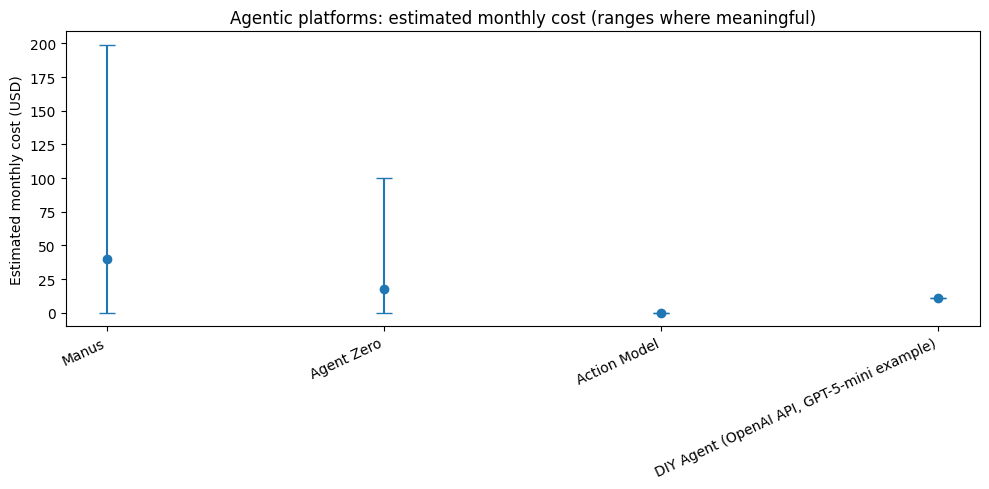
In the graphs, I included an example workload: 5M input + 5M output tokens/month using GPT-5-mini, which comes out to about $11.25/month at list price (purely illustrative).
If you want privacy-first model access for agents
Pick: Agent framework + private API provider option (Venice is often positioned as privacy-focused)
Venice pricing is commonly shown as $18/month for Pro on their pricing page.
If you want the web to become “automatable by observation”
Pick: Action Model
Why: The whole premise is training LAM behavior from browsing traces and rewarding contributors.
What the graphs mean (the ones shown above)
Cost graph
Manus has the clearest subscription tiers (including the $20 and $40 starting points).
Action Model is “$0 cash,” but you are contributing activity/behavior data.
Agent Zero is “$0 framework,” but costs depend on which models you connect and how you run it.
DIY Agent (OpenAI API) can be extremely cost-effective if your tasks are well-defined and you pick the right model tier.
Intelligence and usage graph
Those scores are editorial (not official benchmarks). They reflect:
How much autonomy the system supports in practice
How easy it is to get to results
How strong the reasoning can be, given typical model options